

About Indium
Indium
Indium (chemical symbol In) is a soft, silvery-white metal with a specific gravity of 7.2.
It is produced exclusively as a by-product chiefly from the refining of zinc sulphide (sphalerite) concentrates, with total world refined production in 2025 estimated to be 1,100 tonnes.
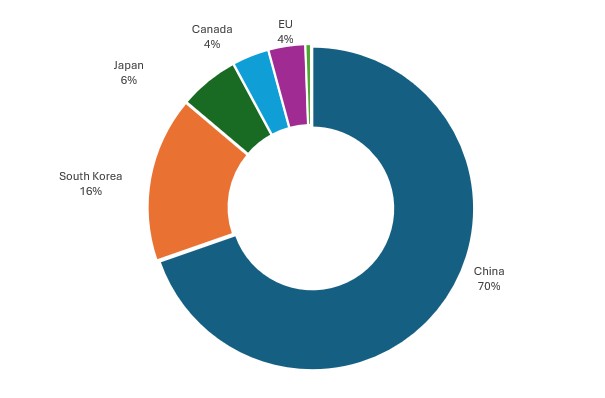
Indium is listed as a critical mineral by most countries due the Chinese dominance of production (70% of global production) and its essential role high tech applications such as thin film displays (indium tin oxide), silicon photonics for high-speed data transmission inside data centres (indium phosphide LEDS) and laser diodes and thin films solar cells.
Production
Global refined production is dominated by China with an estimated market share of 70%.
Source: USGS (2026)
Indium Uses
Indium is one of the most versatile and strategically important metals in the modern economy. Its unique combination of softness, conductivity, and transparency makes it indispensable across multiple industries; from consumer electronics and renewable energy to aerospace, automotive, and medical technology.
Electronics & Displays
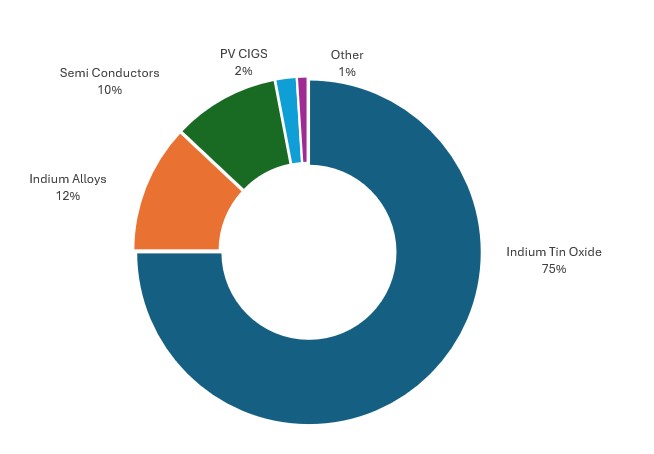
The largest share of global indium demand (approximately 75%) comes from Indium Tin Oxide (ITO) coatings used in LCD, OLED, and touchscreen displays. ITO allows glass to be both
transparent and electrically conductive, an essential property for everything from smartphones, tablets, and televisions to automotive dashboards and smart windows.
Aerospace, Automotive & Industrial Applications (Indium Alloys)
Thanks to its low melting point, malleability, and corrosion resistance, indium is widely used in solders, sealing materials, and heat-transfer interfaces. These characteristics make it valuable in aerospace engineering, automotive electronics, and precision cooling systems where performance under thermal stress is critical. Indium alloys improve reliability in mission-critical environments, from satellites to electric vehicles.
Renewable Energy & Advanced Semiconductors
Indium also plays a key role in the energy transition and high-speed communications. It forms part of CIGS thin-film solar cells, helping convert sunlight into electricity efficiently.
In parallel, compounds such as indium phosphide (InP) and indium gallium arsenide (InGaAs) are essential in optical transceiver components (lasers and photodetectors) which move data through fibre optic (optical communication systems) in 5G networks and AI data centres, all fast-growing markets with strategic importance for national security and digital infrastructure.
Silicon photonics are replacing copper wiring for high-speed data transmission inside AI data centres. Copper based systems are slower than optical connections, operate with lower bandwidth and generate significant heat, especially at the levels reached in data centres. That means more energy is needed for cooling and this lowers overall efficiency.
Source: RFC Ambrian (2025)
Outlook
Indium prices have become increasingly shaped by the tension between rising demand from modern electronics and structurally constrained supply.
This reflects indium’s central role in touchscreens, displays, semiconductors, solar-related technologies, and other advanced industrial applications, combined with a market that depends heavily on by-product supply from zinc processing and limited high-purity refining capacity.